 Mock Interview Copilot
Interview questions by role
Security guard interview questions and answers
Security guard interviews test your judgement, your communication and your reliability more than physical toughness. Expect to be asked how you would deal with an aggressive person, what you would do if you saw someone acting suspiciously, how you write an incident report, when you would call the police or ask for backup, how you stay alert on a quiet night shift, and about your licence or training.
The best answers show that you observe carefully, try to calm situations with words, stay within your role and the law, get help early and record everything accurately.
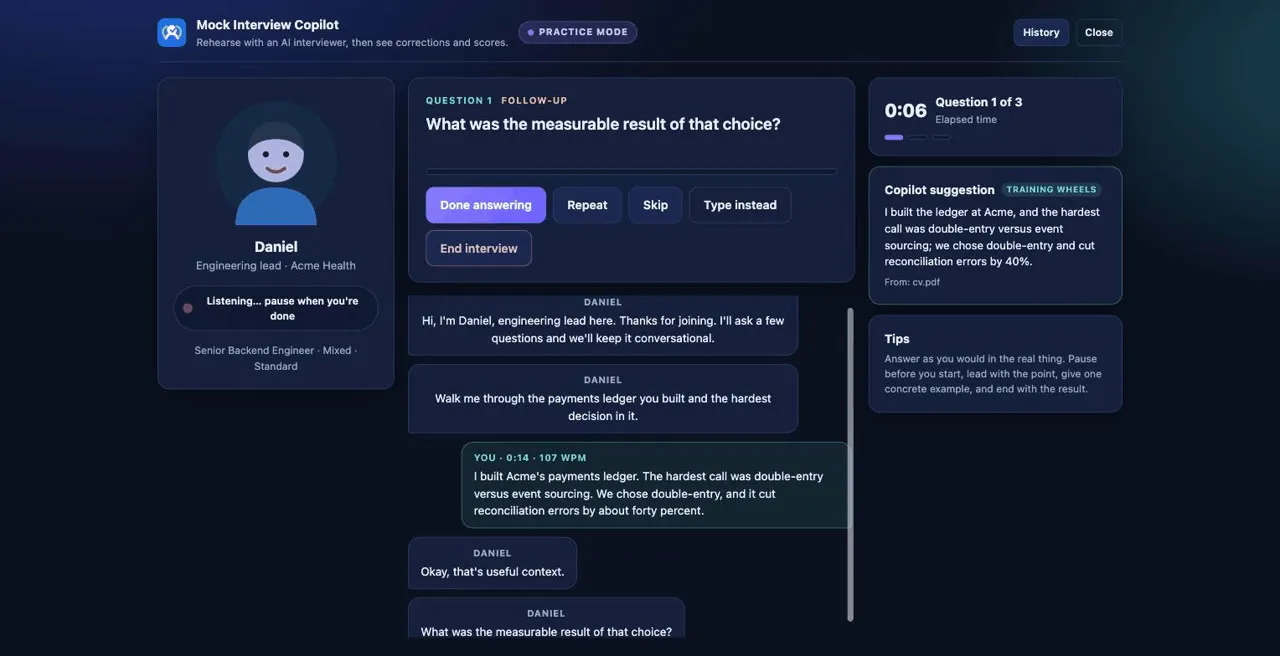
How the interview usually runs
Interviews are usually with a security supervisor or site manager. Employers check that you hold, or can get, the licence the job needs: in the UK that is usually an SIA licence for the relevant activity, and in the US many states require a guard card or license, with extra requirements for armed roles. Rules vary by country and state, so check the job advert. Background checks are standard.
Most of the interview is scenario questions. The interviewer is listening for a safe order of thinking: observe, assess, communicate, de-escalate, call for support when needed and report. They also want reliability, because a security officer who misses a shift or falls asleep leaves a site unprotected.
Common questions and what the interviewer is checking
How would you deal with someone who is becoming aggressive?
What they are checking: De-escalation first: calm voice and body language, keeping a safe distance, listening, giving the person a way out, and calling for backup early. Physical intervention only as a last resort, within training, site policy and the law.
You notice someone acting suspiciously near a restricted area. What do you do?
What they are checking: That you observe and note details, approach politely if safe to do so, ask if you can help, follow site procedure, and report or call for support rather than making assumptions.
When would you call the police?
What they are checking: That you know the threshold: risk to life or safety, a crime in progress, weapons, or a situation beyond your role, and that you also follow the site's escalation procedure and inform your supervisor.
How do you write an incident report?
What they are checking: Factual, timely and detailed: who, what, when, where, what you saw and did, and witnesses, without opinions or guesses.
How do you stay alert on a long, quiet night shift?
What they are checking: Practical habits: varying patrol routes and times, checking in with control, staying hydrated, avoiding distractions such as your phone, and reporting if you feel unfit to work.
A member of staff without a pass asks you to let them in. What do you do?
What they are checking: That you follow access control procedure politely even under pressure, verify identity through the proper route, and do not make exceptions because someone seems senior or familiar.
What would you do if you found a door or alarm compromised during a patrol?
What they are checking: That you keep yourself safe, do not enter alone if there may be someone inside, report to control or your supervisor, follow procedure and record the details.
Do you hold the licence and training needed for this role?
What they are checking: That your licence is current and appropriate for the job, or that you understand what you need to get, and that you will keep training up to date.
Why do you want to work in security?
What they are checking: A sensible reason, such as protecting people and property, and an understanding that much of the job is observation, patrols, reporting and customer service rather than confrontation.
How to structure a strong answer
For scenario questions, describe your actions in a safe order, and say out loud the moments where you would call for support and record what happened. For “Tell me about a time…” questions, use STAR with any example where you stayed calm, followed a procedure or handled a difficult person.
- Observe and assess: what you see, and whether anyone is at risk.
- Communicate: approach calmly if safe, listen, and explain the rules or options.
- Escalate: call control, your supervisor or the police as soon as the situation needs it.
- Report: write it up factually, the same shift, with times and witnesses.
Example answer
How would you deal with someone who is becoming aggressive?
My priority is keeping everyone safe, including the person and myself. I would keep a safe distance, keep my hands visible and speak calmly and slowly. I would ask what the problem is and listen, because a lot of aggression comes from feeling ignored. If I can, I would offer a way out, such as stepping to a quieter area or another option to solve their problem.
I would radio control or my colleague early, before things get worse, so support is on the way. If the person threatened anyone or became violent, I would call the police and follow site procedure, and only use physical intervention as a last resort within my training and the law.
When I worked on a shop floor, a customer started shouting at a young colleague over a refund. I stood next to my colleague, spoke calmly to the customer, got the manager on the radio, and moved the conversation to the customer service desk. It calmed down within a few minutes, and I wrote a short note of what happened for the manager.
Mistakes to avoid
- Talking up physical confrontation or sounding eager for it. Employers want people who prevent incidents.
- Leaving out the report. If it is not written down, the incident is hard to act on later.
- Saying you would chase or detain someone without mentioning safety, site policy, your training and the law.
- Bending access rules for someone who seems important.
- Underplaying reliability and alertness on night shifts.
- Not knowing which licence the role needs.
Frequently asked questions
What questions are asked in a security guard interview?
Expect scenarios about aggressive people, suspicious behaviour, access control and compromised doors or alarms, plus questions on writing incident reports, when to call the police, staying alert on night shifts, your licence and why you want the job.
How do I answer “how would you handle an aggressive person” in a security interview?
Describe keeping a safe distance, staying calm, listening, offering a way out and calling for backup early, with physical intervention only as a last resort within your training, site policy and the law. Finish by saying you would write a report.
Do I need a licence to work as a security guard?
In many places, yes. In the UK most security roles need an SIA licence, and in the US many states require a guard card or license. Requirements vary, so check the job advert and the rules where you will work.
Can I become a security guard with no experience?
Many employers hire people new to security once they have the required licence or training. Use examples from customer service, retail or hospitality that show calm communication and reliability.