 Mock Interview Copilot
Interview questions by role
Librarian interview questions
Librarian interviews test whether you can connect people with information, run services your community actually uses, and handle the public with patience. Expect questions about a reference question you answered well, how you teach information literacy, a programme or event you planned, how you would deal with a disruptive or upset patron, how you respond to a complaint about a book, how you use technology, and why this type of library suits you.
The emphasis shifts by setting: public libraries focus on community and outreach, school libraries on reading and teaching, and academic libraries on research support.
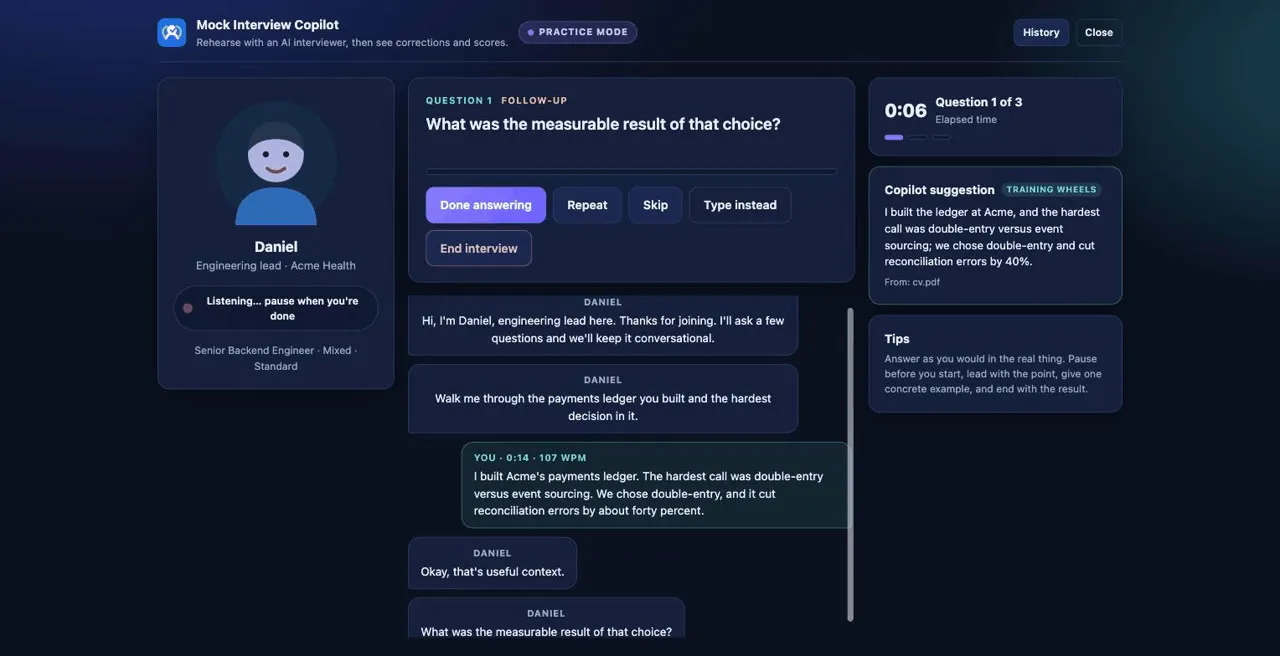
How the interview usually runs
Interviews are usually a panel: a library manager or head of service, a senior librarian, and sometimes someone from HR, a school leader or an academic department. Many include a presentation, for example on how you would increase library use by a particular group, or a short teaching demonstration. Academic roles may involve meeting faculty or students. In the US, professional librarian posts usually ask for a master's degree accredited by the American Library Association; in the UK, a CILIP-accredited qualification or chartership is often valued. Library assistant roles focus more on customer service and lending.
Panels look for a service mindset as much as subject knowledge. They want to hear that you are curious about what users need, comfortable teaching people of all ages and confidence levels, fair and calm in difficult situations, and able to back decisions with the library's policies. Before the interview, look at the library's published plans, current events and online services.
Common questions and what the interviewer is checking
Why do you want to work in this library, and in this type of library?
What they are checking: That you understand who uses a public, school or academic library and have looked at this library's services, events and plans.
Tell me about a reference question you answered well.
What they are checking: A good reference interview: open questions to find out what the person really needed, a sound search, showing them how you found it, and checking it answered their question.
How do you teach information literacy?
What they are checking: Practical teaching: helping people judge sources, spot misinformation and search effectively, adjusted for children, students or adults.
Tell me about a programme or event you planned. How did you know it worked?
What they are checking: Planning and evaluation: identifying a need, working with partners where useful, promoting it, and judging success by attendance, feedback or what people did next.
How would you deal with a patron who is shouting or disturbing others?
What they are checking: Calm de-escalation: approaching respectfully, explaining the policy, offering options, keeping yourself and others safe, and calling a colleague or security when needed.
A parent complains that a book in the children's section is inappropriate. What do you do?
What they are checking: That you listen respectfully, explain the collection policy and the formal reconsideration process, do not remove the item on the spot, and pass the request on as the policy says.
How would you reach people who do not use the library?
What they are checking: Outreach thinking: identifying the group, understanding their barriers, working with partners and trying services that fit their lives.
How do you use technology to improve library services?
What they are checking: Comfort with catalogues, databases, e-resources and digital skills support, and patience with users who find technology difficult.
How do you decide what to add to or remove from a collection?
What they are checking: Collection development grounded in user needs, usage, the written policy and a balanced range of viewpoints.
Tell me about a time you worked with teachers, faculty or community partners.
What they are checking: Collaboration: shared goals, clear communication and a result that served users.
How to structure a strong answer
Use STAR for experience questions and keep the user at the centre: who needed what, and how you helped them find it or learn it. For scenarios, show the order you would act in: listen, explain the policy, offer options, involve a colleague or manager, and record what happened.
- Situation: the library, the user or group, and the need.
- Task: what you were trying to achieve for them.
- Action: what you did, including how you taught, planned or calmed things down.
- Result: what changed for the users or the service, and how you knew.
Example answer
Tell me about a programme you planned that brought in new users.
At the public library where I worked as a library assistant, very few older adults used our e-book and online services, yet many asked at the desk how to read the newspaper on a tablet. I suggested a weekly drop-in session and planned it with my manager.
We kept it informal: one table, a few library tablets, and printed one-page guides I wrote for the most common questions, such as borrowing an e-book or video-calling family. I promoted it with posters at the desk and through a local older people's group, and recruited two volunteers from a nearby college so everyone got individual help.
Over the first three months, regular attendance grew from four people to around fifteen, and several started borrowing e-books for the first time. The feedback cards asked for a session on staying safe online, so we added one. What I learned is that the best programmes start with the questions people are already asking at the desk.
Mistakes to avoid
- Talking about loving books and reading, with little about serving users, teaching or community.
- Answering a reference scenario by searching straight away instead of first finding out what the person really needs.
- Saying you would remove a challenged book immediately, or dismiss the complaint, rather than following the reconsideration policy.
- Knowing nothing about the library's users, events or plans.
- Describing a programme without saying how you knew it worked.
- Sounding uncomfortable with technology or with difficult patrons, both of which are daily parts of the job.
Frequently asked questions
What questions are asked in a librarian interview?
Why this library, a reference question, teaching information literacy, a programme you planned, a difficult patron, a book complaint, outreach, technology, collection development and partnerships.
How do I answer the difficult patron question in a library interview?
Describe staying calm and respectful, listening, explaining the relevant policy, offering options, keeping others safe, and involving a colleague, manager or security if it escalates, then recording what happened. A real example helps.
What is a reference interview?
It is the conversation a librarian has with a user to find out what they really need, using open questions, before searching. Interviewers often ask you to describe one because it shows your listening and search skills.
Do I need a library degree to be a librarian?
Professional librarian posts in the US usually require a master's degree accredited by the American Library Association. In the UK, a CILIP-accredited qualification is often preferred. Library assistant roles usually do not require one.